Buying a used Mitsubishi L200
Mitsubishi L200 Overview: The UK's Workhorse Pickup
The Mitsubishi L200 has been a bedrock of the UK light commercial vehicle sector for over three decades. When tradespeople, agricultural contractors, and fleet operators search for a pickup truck that bridges the divide between an indestructible site vehicle and an everyday family commuter, the L200 routinely tops the shortlist. Although Mitsubishi withdrew new passenger car and commercial sales from the UK market in late 2021, the L200 remains one of the most supported, widely driven, and easily serviced pickups on British roads. Parts distribution, warranty support, and servicing networks were transferred to the International Motors group, ensuring that used buyers face no shortage of spare components, specialist diagnostics, or workshop expertise.
Across its production run, the L200 built its reputation on three key pillars: mechanical simplicity, lightweight manoeuvrability compared to bulkier American-style rivals, and genuine all-terrain capability. Unlike competitors that often feel unwieldy down narrow rural lanes or on congested residential jobs, the L200 has historically maintained a tighter turning circle than the Ford Ranger, Toyota Hilux, and Nissan Navara. This agility makes it particularly popular with urban building contractors, landscapers, and utility workers who need to navigate tight construction sites and domestic driveways without sacrificing load capacity.
Most used buyers focus on two distinct generations: the Series 5, sold between 2015 and 2019, and the Series 6, sold from late 2019 until sales ceased in 2021. Older Series 4 models (2006 to 2015) remain widely available as budget-friendly tools for yards, farms, and groundwork crews, but require a sharper eye for wear, tear, and structural corrosion. Understanding how these generations differ mechanically, cosmetically, and dynamically is critical to choosing the right pickup for your trade.
Drivetrain and the Super Select 4WD Advantage
One of the primary technical reasons tradespeople choose a used Mitsubishi L200 over alternative pickups is its four-wheel-drive hardware. Mitsubishi equipped different trims with two distinct systems: Easy Select and Super Select 4WD.
Base-spec commercial models, such as the 4Work and 4Life, generally feature the standard Easy Select system. This is a conventional part-time four-wheel-drive setup. On dry tarmac, it must be driven strictly in rear-wheel drive. Engaging four-wheel drive locks the front and rear prop shafts together at equal speeds; driving on high-traction surfaces in this mode causes drivetrain binding, axle wind-up, and catastrophic transfer box or differential damage. It is designed solely for use on mud, snow, wet grass, and loose gravel.
Higher-specification models—including the Titan, Warrior, Barbarian, and Barbarian X—come equipped with Mitsubishi’s sophisticated Super Select 4WD (known as Super Select II on Series 5 and 6 models). This system incorporates a central differential with a viscous coupling unit. As a result, the driver can shift from rear-wheel drive to four-wheel drive at speeds up to sixty miles per hour and, crucially, leave the vehicle in four-wheel drive permanently on dry or greasy tarmac. For a British tradesperson towing a heavy plant trailer on cold, damp mornings or tackling winding A-roads in torrential rain, Super Select provides unmatched active safety and traction without the risk of mechanical damage.
The Super Select rotary dial offers four distinct modes:
- 2H (High Range Rear-Wheel Drive): Ideal for dry motorway cruising and unladen driving, delivering maximum fuel economy.
- 4H (High Range Full-Time Four-Wheel Drive): Splits drive between front and rear axles dynamically, safe to use on any surface including dry asphalt.
- 4HLc (High Range Four-Wheel Drive with Locked Centre Differential): Distributes torque equally front and rear for low-traction scenarios like deep mud, rutted tracks, and snow.
- 4LLc (Low Range Four-Wheel Drive with Locked Centre Differential): Delivers extreme low-ratio crawl gearing for steep ascents, descending treacherous inclines, pulling heavy plant out of boggy ground, or delicate low-speed trailer manoeuvres.
Body Styles, Dimensions, and Working Specifications
To ensure a used pickup functions effectively as a daily commercial tool, you must match the body style and dimensions to your trade requirements. The Mitsubishi L200 was offered in three primary body configurations throughout its lifecycle, though the Double Cab represents the overwhelming majority of used examples on the UK market.
Body Configurations
- Single Cab: Features two doors, two seats, and an extended load bed measuring over two metres in length. Highly sought after by forestry workers, agricultural fencing contractors, and municipal services, but rare on the used market.
- Club Cab: Features reverse-opening rear suicide doors and two occasional fold-down jump seats in the back. The load bed measures approximately 1.85 metres, making it an excellent compromise for tradespeople who need extra secure internal storage for expensive tools while retaining a longer bed than a dual-cab pickup.
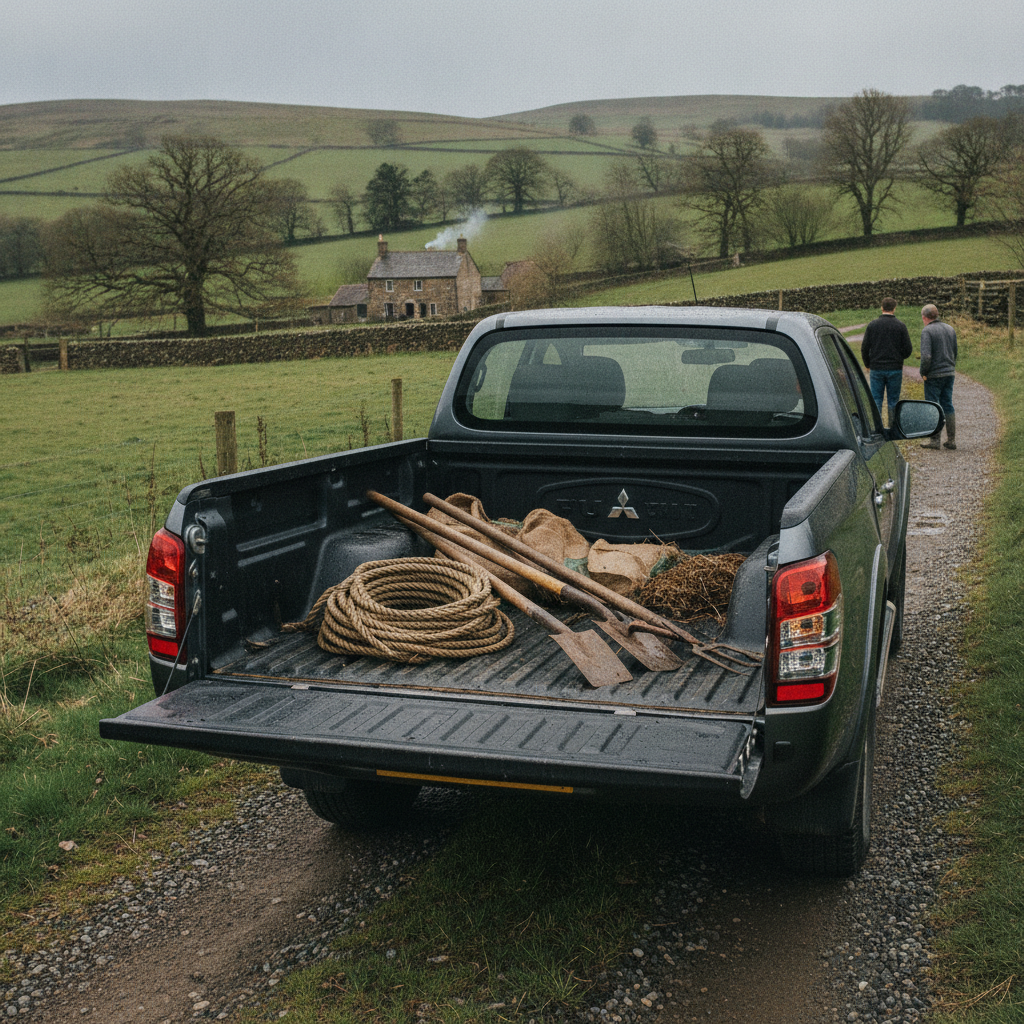
- Double Cab: Features four standard doors, a full five-passenger cabin, and a load bed length of roughly 1.52 metres. This is the dominant model on the used market, catering to trades who transport multi-person crews to sites throughout the week and require family utility on weekends.
Payload and Load Bed Practicalities
Payload capacity is a crucial consideration for any commercial operator. In the UK, a dual-cab pickup must have a minimum payload capacity of one metric tonne (one thousand kilograms) to qualify as a light commercial vehicle for HM Revenue and Customs purposes, allowing VAT-registered businesses to reclaim the input VAT. The L200 comfortably clears this hurdle across virtually all model derivatives, with typical payloads ranging between 1,045 kilograms and 1,080 kilograms depending on the trim level and fitted accessories.
The bed width measures approximately 1.47 metres, with 1.08 metres of clearance between the rear wheel arches. While this means a standard eight-by-four sheet of plasterboard or plywood cannot lay completely flat on the bed floor between the arches, sheets can easily be carried diagonally, on custom load racks, or atop a fitted roller shutter or canopy roof system. Six sturdy tie-down points are integrated into the inner load bed walls as standard.
Towing Limits and Train Weight
Towing capacity varies depending on the generation and production year. Series 4 models were historically rated to tow between 2,700 kilograms and 3,000 kilograms on a braked trailer. Series 5 models expanded this capability; early versions were rated for 3,100 kilograms, which Mitsubishi later upgraded to the full industry-standard 3,500 kilograms on three-axle trailers (or 3,100 kilograms on two-axle trailers) to match competitors like the Isuzu D-Max and Ford Ranger. Series 6 models carry a maximum braked towing rating of 3,500 kilograms. Combined with a gross train weight approaching six tonnes, the L200 is fully rated to haul mini-diggers, tracked access equipment, livestock boxes, or car transporters.
Engine Options Across the Generations
Understanding which engine powers the used L200 you are considering is vital for predicting reliability, maintenance costs, and emissions compliance.
2.5-Litre DI-D (Series 4: 2006–2015)
The venerable 2.5-litre four-cylinder common-rail diesel (engine code 4D56) is a cast-iron block unit known for simplicity and toughness. In standard guise, it produced 134 brake horsepower, while higher-spec Barbarian and Warrior variants were boosted to 175 brake horsepower with 400 Newton-metres of torque. This engine relies on a traditional toothed timing belt rather than a timing chain, requiring replacement every five years or 62,500 miles. These vehicles are non-AdBlue and Euro 4 or Euro 5 compliant, meaning they are subject to emissions charges in Clean Air Zones and London's ULEZ.
2.4-Litre DI-D MIVEC (Series 5: 2015–2019)
For the Series 5, Mitsubishi introduced an all-aluminium four-cylinder diesel (engine code 4N15) featuring variable valve timing—a first for a pickup truck. It came in two outputs: a 151 brake horsepower entry tune and a high-output version producing 178 brake horsepower and 430 Newton-metres of torque. It reduced kerb weight significantly and improved fuel economy. Early versions met Euro 6 emissions regulations without the need for an AdBlue tank by using an advanced Lean NOx Trap system, though late 2018-onwards models transitioned toward updated emissions hardware. This engine uses a timing chain rather than a rubber belt.
2.2-Litre DI-D (Series 6: 2019–2021)
To comply with stringent Euro 6d-Temp emissions standards, Mitsubishi replaced the 2.4-litre unit with a thoroughly reworked 2.2-litre turbodiesel (engine code 4N14). Output dropped on paper to 148 brake horsepower and 400 Newton-metres of torque, but the engine was paired with a much slicker six-speed Aisin automatic gearbox (replacing the older five-speed auto) or an improved six-speed manual. This engine requires AdBlue, with the filler neck located behind the fuel flap. Power delivery is smooth and linear, offering quiet motorway cruising speeds even if it lacks the outright punch of the earlier 178 horsepower unit.
Who Buys a Used Mitsubishi L200 and Why?
The Mitsubishi L200 attracts a broad spectrum of commercial users across the UK light commercial sector due to its running efficiency, mechanical resilience, and dual-purpose capability.
Building, Groundwork, and Construction Trades
General builders, bricklayers, civil engineers, and groundwork contractors choose the L200 because it thrives in hostile job site environments where ordinary panel vans quickly become stranded or suffer underbody damage. The high ground clearance, steel underbody skid plates, and robust ladder-frame chassis allow it to traverse rutted access tracks, loose aggregates, and waterlogged building plots without hesitation. The double-cab configuration serves as a mobile mess room and office for on-site staff.
Agriculture, Forestry, and Arboriculture
Tree surgeons, farmers, estate managers, and fencing contractors frequently operate in environments that demand genuine off-road capability. With a bed cap or high-sided canopy fitted, the L200 carries chainsaws, climbing gear, fuel canisters, and chemical sprayers securely. The low-range transfer gearbox allows operators to reverse heavy timber trailers uphill or pull fully loaded livestock trailers through saturated fields without burning out the clutch.
Plant Hire, Equipment Towing, and Recovery
Because higher-specification Series 5 and 6 models feature a 3.5-tonne towing limit, they are workhorses for tool hire depots, access platform operators, and vehicle transport specialists. The ability to pull tandem-axle plant trailers laden with micro-excavators or compaction rollers while carrying replacement fuel, generators, and accessories in the rear bed gives small firms the capabilities of a much larger commercial rig.
Tax and Commercial VAT Advantages
For sole traders, limited companies, and partnerships, purchasing a used L200 brings clear fiscal benefits compared to an equivalent large four-wheel-drive passenger car. Because it is classified as a light commercial vehicle with a payload exceeding one tonne, VAT-registered businesses can reclaim the full twenty percent VAT on the purchase price, provided the vehicle is used for commercial activities. Furthermore, company car drivers benefit from fixed, flat-rate Benefit-in-Kind (BIK) taxation rather than emissions-based percentage bands, resulting in significant annual income tax savings.
Used Mitsubishi L200 Inspection Checklist: What to Look For
Buying a used commercial vehicle always carries risk, particularly with pickups that may have endured heavy towing, overloaded beds, and off-road abuse. Use this checklist during every vehicle inspection.
1. Chassis Integrity and Underbody Corrosion
The ladder-frame chassis is the structural foundation of the L200. On Series 4 models, chassis corrosion is a known vulnerability, especially around the rear suspension spring hangers and the mid-chassis rails where dirt, road salt, and moisture collect. Mitsubishi issued safety recalls on older variants to inspect and apply anti-corrosion treatments or weld reinforcement plates. Bring a torch and an inspection probe: examine the chassis rails thoroughly. Surface rust is normal on thick structural steel, but delaminating scale, flaking metal, or holes mean the vehicle should be rejected immediately. On Series 5 and 6 models, check for underbody impact damage, crushed crossmembers, or bent diff guards from off-roading.
2. Engine Head Gasket and Cooling System Checks
When inspecting a Series 5 model with the 2.4-litre aluminium engine, pay meticulous attention to the cooling system. A documented issue on early 2.4-litre models involves head gasket failure or cylinder block issues resulting from thermal stress. When the engine is cold, remove the expansion tank cap and check for oil contamination or dark exhaust staining. Start the engine, let it reach operating temperature, and check for bubbling inside the coolant reservoir. Squeeze the top radiator hose: if it feels rock-hard and excessively pressurised while the engine runs, combustion gases are leaking into the water jacket. Replacing a head gasket on this engine is a labour-intensive and costly undertaking.
3. Four-Wheel Drive Actuation
Test the four-wheel-drive system thoroughly on an appropriate loose gravel or grassy surface—never on dry asphalt. Move the selector dial through 2H, 4H, 4HLc, and 4LLc. Watch the instrument cluster: the green wheel indicators should turn solid, not continue to flash indefinitely. A flashing 4WD light indicates that the vacuum actuators, front axle freewheel switch, or transfer box solenoids are stuck or failing. While often caused by split vacuum pipes or corroded sensors, tracing electrical faults across the Super Select transfer case requires specialist diagnostic equipment.
4. Rear Leaf Springs and Suspension Bushings
The rear suspension relies on multi-leaf steel springs. Inspect each spring leaf from front hanger to rear shackle. Overloading or repeatedly bottoming out over rough terrain can cause the bottom helper leaf or second leaf to snap, usually close to the central axle clamping plate. Check that the vehicle sits level across the rear axle; a noticeable list to one side indicates broken leaves or collapsed spring mounts. During the test drive, listen for knocks or rattles over speed bumps, which point to worn front anti-roll bar drop links, deteriorated lower ball joints, or perished rear shackle bushes.
5. Clutch and Gearbox Health
On manual variants, test the clutch under load. Engage a high gear at low speed while ascending an incline and accelerate; any engine flare without matching vehicle acceleration confirms clutch slippage. Heavy towing takes a heavy toll on the standard clutch and dual-mass flywheel. On automatic models, ensure shifts between first, second, and third gear are crisp and imperceptible. Hesitation, flaring revs between gear changes, or shuddering under acceleration indicates aged, degraded automatic transmission fluid or failing torque converter lock-up clutches.
6. Oil Dilution and DPF Health
Pull the engine oil dipstick. On Series 5 and 6 models, the dipstick features three markings: Low, Full, and an 'X' stamped further up the blade. If the oil level sits at or above the 'X', the engine is suffering from excessive diesel dilution. This happens when the vehicle attempts active DPF regenerations but gets aborted repeatedly due to short, low-speed urban journeys, causing unburnt diesel to run past the piston rings into the sump. Running an engine with fuel-diluted oil accelerates bearing wear and can cause catastrophic engine runaway.
Mitsubishi L200 Generations and Years to Avoid
While the L200 has earned a stellar reputation overall, certain model years present higher risks for used buyers:
- Early Series 4 Models (2006 to 2009): These models have seen heavy commercial service and are prone to severe chassis corrosion around the rear spring mounts. Many have had timing belt changes neglected or suffered cylinder head cracks on poorly maintained 2.5-litre engines. They are best avoided unless you have verified complete service records and rust-free structural steel.
- Early Series 5 Models (2015 to Mid-2016): Early production runs of the 2.4-litre all-aluminium engine were subject to technical service bulletins regarding block manufacturing tolerances, leading to premature head gasket failure, oil consumption, and overheating. Vehicles built from 2017 onwards received updated components and are considerably more reliable.
- Ex-Utility and Fleet Base Models: While competitively priced, basic 4Work models from plant hire, forestry, or civil contracting fleets often suffer from neglected maintenance, constant over-revving from cold, heavily dented load beds, and chassis packed solid with corrosive road mud and slurry.
Used Mitsubishi L200 Market Values
Used L200 pricing varies based on generation, mileage, mechanical health, and interior specification. Remember that prices in the commercial vehicle market are typically quoted exclusive of VAT.
Budget Workhorses: Under £8,000
In this entry-level price bracket, you will primarily encounter later Series 4 models (2011 to 2015) and high-mileage early Series 5 commercial-spec models (2015 to 2016). Expect odometers displaying over 120,000 miles. Vehicles in this range usually show signs of trade wear: scratch marks inside the bed, small panel dings, and stone chipping. Prioritise structural condition and mechanical health over cosmetic perfection. Check for proof of timing belt replacements on 2.5-litre units and verify that the 4WD system functions without warning lights.
Mid-Range Fleet and Trade Models: £8,000 to £15,000
This bracket represents the core buying territory for tradespeople seeking a dependable, modern work vehicle. It includes tidy Series 5 models from 2016 through 2019, generally covering Titan, Warrior, and early Barbarian trim levels with between 50,000 and 90,000 miles. At this level, you can secure Euro 6 compliant models suitable for working inside urban low-emission areas. Look for single-owner fleet returns or owner-driver trade vehicles that have a full stamped service book, documented DPF maintenance, and clean MOT histories.
Late-Plate and Low-Mileage Models: £15,000 to £23,000+
The upper tier of the used market covers late-plate Series 5 pickups (2019) and the updated Series 6 models (late 2019 to 2021), including high-specification Barbarian and Barbarian X trims. Expect low mileages—often under 45,000 miles—with luxury appointments such as heated leather seats, 360-degree parking cameras, lane-departure warnings, and advanced smartphone infotainment. These vehicles are ideal for trade business owners who use their pickup as a primary client-facing vehicle and luxury family transport outside of working hours.
Running Costs: Fuel, Road Tax, Insurance, and Servicing
Budgeting accurately for ongoing ownership costs ensures your used pickup remains profitable to operate.
Fuel Economy
Real-world fuel consumption depends heavily on vehicle loading, fitted accessories (such as roof racks and canopies), tyre tread patterns, and driving style:
- Series 4 (2.5 DI-D): Returns between 26 and 31 miles per gallon under mixed driving conditions, dropping to the low twenties when towing heavy loads.
- Series 5 (2.4 DI-D): The most economical generation. Unladen motorway cruising can achieve up to 36 to 38 miles per gallon, while everyday trade use averages between 30 and 34 miles per gallon.
- Series 6 (2.2 DI-D): Delivers roughly 29 to 33 miles per gallon in typical mixed driving. Remember to factor in the consumption of AdBlue, which typically requires replenishing every 5,000 to 7,000 miles depending on workload.
Road Tax (Vehicle Excise Duty)
Because the Mitsubishi L200 is registered as a light commercial vehicle (category N1), it falls under flat-rate commercial vehicle tax rather than the sliding CO2 emissions-based tax applicable to passenger cars. This provides predictable, stable annual running costs, shielding you from expensive luxury car supplements regardless of how high the original factory retail price was.
Insurance Groups
Insurance ratings for the L200 range from Group 37 on basic 4Life models up to Group 43 on top-spec Barbarian and Barbarian X variants. Because pickups are high-value targets for tool theft and catalytic converter theft, fitting a Thatcham-approved tracker, deadlocks on hardtops, and catalytic converter guards can help reduce annual insurance premiums with commercial underwriters.
Routine Servicing and Maintenance Intervals
Service intervals on Series 5 and Series 6 models are set at every 12,500 miles or twelve months, whichever arrives first. Sticking to regular oil changes using the correct low-SAPS synthetic oil is non-negotiable to protect the variable-vane turbochargers and prevent DPF blockages. The International Motors parts network maintains a comprehensive inventory of genuine replacement parts, while the L200's widespread popularity means quality aftermarket components—such as brake discs, pads, shock absorbers, and leaf springs—are readily available from trade factors at reasonable prices.
Financing Your Used Mitsubishi L200
When securing a used pickup for your business, structuring the purchase correctly helps protect cash flow and balances operational overheads. Business buyers typically have two primary routes: hire purchase and leasing solutions.
Hire Purchase allows your business to spread the capital cost over a fixed term—usually between two and five years. You pay an initial deposit, followed by fixed monthly payments, with ownership transferring to your business once the final option-to-purchase fee is cleared. For VAT-registered businesses, the full VAT on the purchase price is normally paid upfront as part of the deposit, which can then be reclaimed on your next quarterly VAT return. To explore flexible purchasing arrangements tailored to your turnover, check your options through van finance specialists who understand light commercial vehicle underwriting.
Alternatively, if you prefer lower monthly outgoings without the risks of long-term depreciation and disposal logistics, exploring commercial agreements or modern van lease deals can offer tax-efficient alternatives, allowing you to treat payments as an operational expense against gross profits. Reviewing your cash flow, mileage expectations, and tax positioning with your accountant will determine whether purchasing outright or financing provides the greatest return for your business.
Summary: Is a Used L200 Right for Your Business?
The Mitsubishi L200 remains one of the smartest, most dependable used pickup purchases available in the UK. While newer rivals have grown increasingly heavy, complex, and expensive, the L200 maintains a sensible footprint, genuine off-road agility, and practical mechanical underpinnings. The exceptional Super Select 4WD system provides year-round road safety and job-site competence that few direct competitors can match.
By avoiding early, abused workhorses, diligently checking chassis rails for corrosion, inspecting the cooling system and oil levels on 2.4-litre engines, and demanding evidence of regular servicing, you can secure a rugged, high-performing commercial asset that will work hard for your business for years to come.